"So what am I actually going to get paid???"
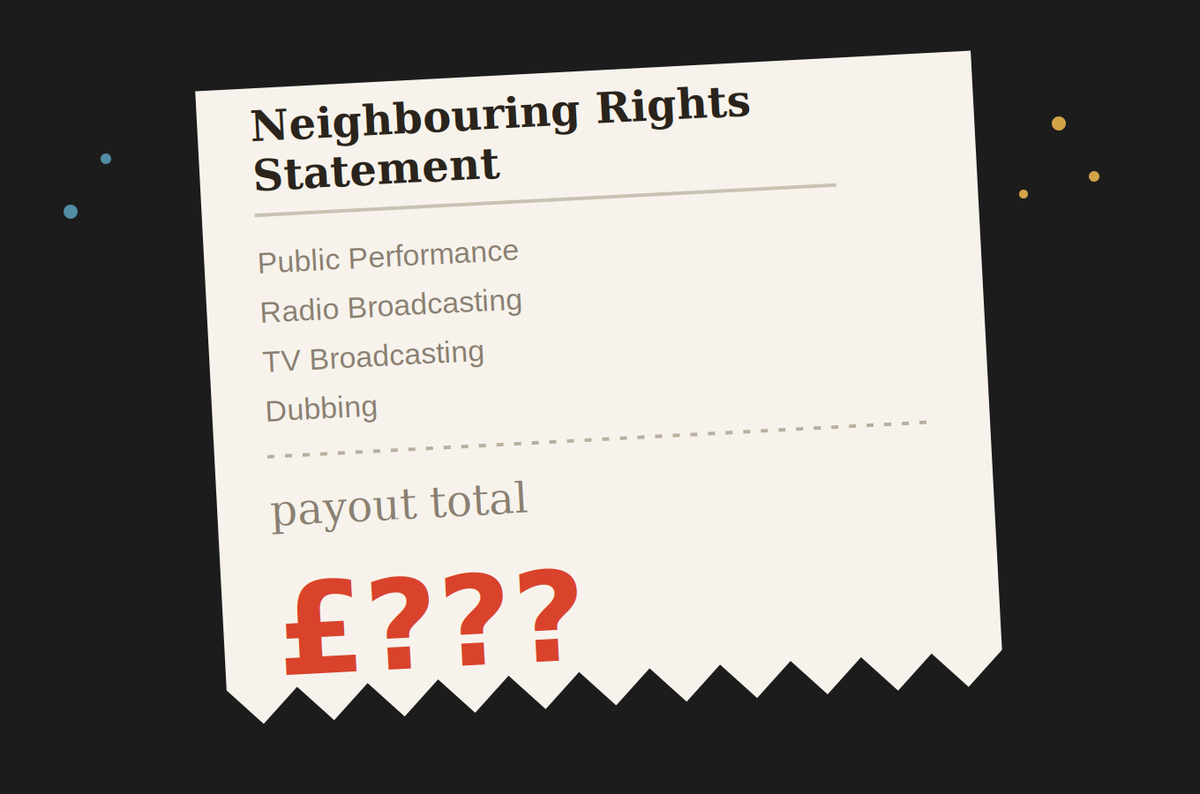
What actually determines how much you get paid?
We've talked about why neighbouring rights (NR) matters, how big the market really is and how to choose the right partner to collect it for you. But there's one question that comes up in almost every conversation we have with artists, labels and rights owners, and it's usually asked with a slightly nervous laugh: "okay, but how much am I actually going to get?"
It's a fair question, and an annoyingly hard one to answer in a single sentence, because NR royalties aren't calculated the same way twice. Unlike a mechanical royalty, where a rate is fixed and the maths is (relatively) simple, NR payments are the product of a tangle of local rules, licence types and reporting methods that vary from society to society. So rather than give you a number, which would be more or less meaningless out of context, we want to walk you through the actual levers that determine what lands in your account.
It starts with usage, not popularity
The first thing to untangle is that NR isn't paid out based on how good, or even how popular, a track is in some abstract sense. It's paid based on recorded usage. Specifically, broadcast and public performance of a sound recording. Radio play, TV needle-drops, background music in bars, restaurants and shops, some digital and simulcast use depending on territory; all of this generates a licensable "performance" of a recording, and it's these performances that societies are tracking and monetising on your behalf.
This matters because it means a track that streams well but gets little radio play in a given territory can earn very little NR there, while a track that's a modest streaming performer but a broadcast staple can earn substantially more. The two revenue streams (streaming royalties and NR) are related but not remotely proportional, and conflating them is one of the most common sources of confusion we see.
Then it's about how usage is measured
Once you've established that a recording has been used, the next variable is how that usage gets counted, and this differs enormously by society.
Some societies work, in the main, from full census data; actual logs of what was played, when, and by whom, usually supplied by broadcasters themselves. This is the gold standard, because it means you're paid according to your recording's real, tracked usage.
Others rely on sampling. A radio station might report a representative week or month of playlists and the society extrapolates payments across the year based on that sample. If your track was heavily played in the sampled period, you may do very well; if it happened to miss the sampled window, you could be underpaid for usage that genuinely happened. This is one of the (many) reasons it's worth having someone monitoring your collections rather than assuming that what comes in reflects what was actually played.
Then there's the pot of money that gets distributed on market share or genre-based formulas where individual usage data isn't available at all, particularly in smaller or less digitised societies. Here, payment is more of an estimate based on your relative presence in a market than a direct reflection of specific plays.
The rate itself: statutory vs negotiated
In some territories (the US via SoundExchange being the best-known example), the NR rate for digitally broadcasted performances is set by statute, so there's a published, fixed methodology behind what a given "spin" or play is worth. In most of the rest of the world, rates relating to the broadcast element of NR are the product of collective negotiations between societies and broadcasters, often reviewed periodically, and they can vary hugely by usage type. TV pays differently from radio, prime-time differently from overnight, national broadcasters differently from regional or local ones.
The performer/rightsholder split
Almost everywhere, NR income is split between the rightsholder (typically the label or the person who commercially released the recording) and the performers on that recording. Sometimes just featured performers, sometimes non-featured/session performers too, depending on local rules. The split itself varies by territory. A 50/50 split is common, but it isn't universal, and who counts as a "performer" for these purposes differs from society to society. This is a genuinely common source of underpayment, because if performers aren't correctly identified and registered as having contributed audibly to a recording, their share can go unclaimed, or worse, get paid to the wrong party entirely.
Currency, timing and deductions
Two more practical factors that quietly affect what you actually receive: exchange rates at the point of conversion and the various deductions that can be taken out before money reaches you. These deductions include administration fees charged by the society itself (separate from any commission your NR partner takes) and withholding tax, depending on your territory of residence and any relevant treaties in place between that territory and the territory that is the source of the income.
So, what determines your number?
Put it all together and your NR income for any given recording, in any given territory, is a function of how much it was genuinely used, how well that usage was captured (census vs sample vs estimate), the rate applied to that usage type, how the resulting money is split between rightsholder and performer(s) and what's deducted before it reaches you. None of these variables are things you can control directly, but nearly all of them are things you can monitor, and monitoring is where real money tends to get recovered.
This is exactly why we keep coming back to the same advice in this blog. Get registered properly, understand who's collecting for you and how, and ask questions when the numbers don't add up. As always, we're happy to talk through your specific situation — get in touch.